Pens that weren't pens
By James (Nibfolio Co-Founder) · 45 min read · stories
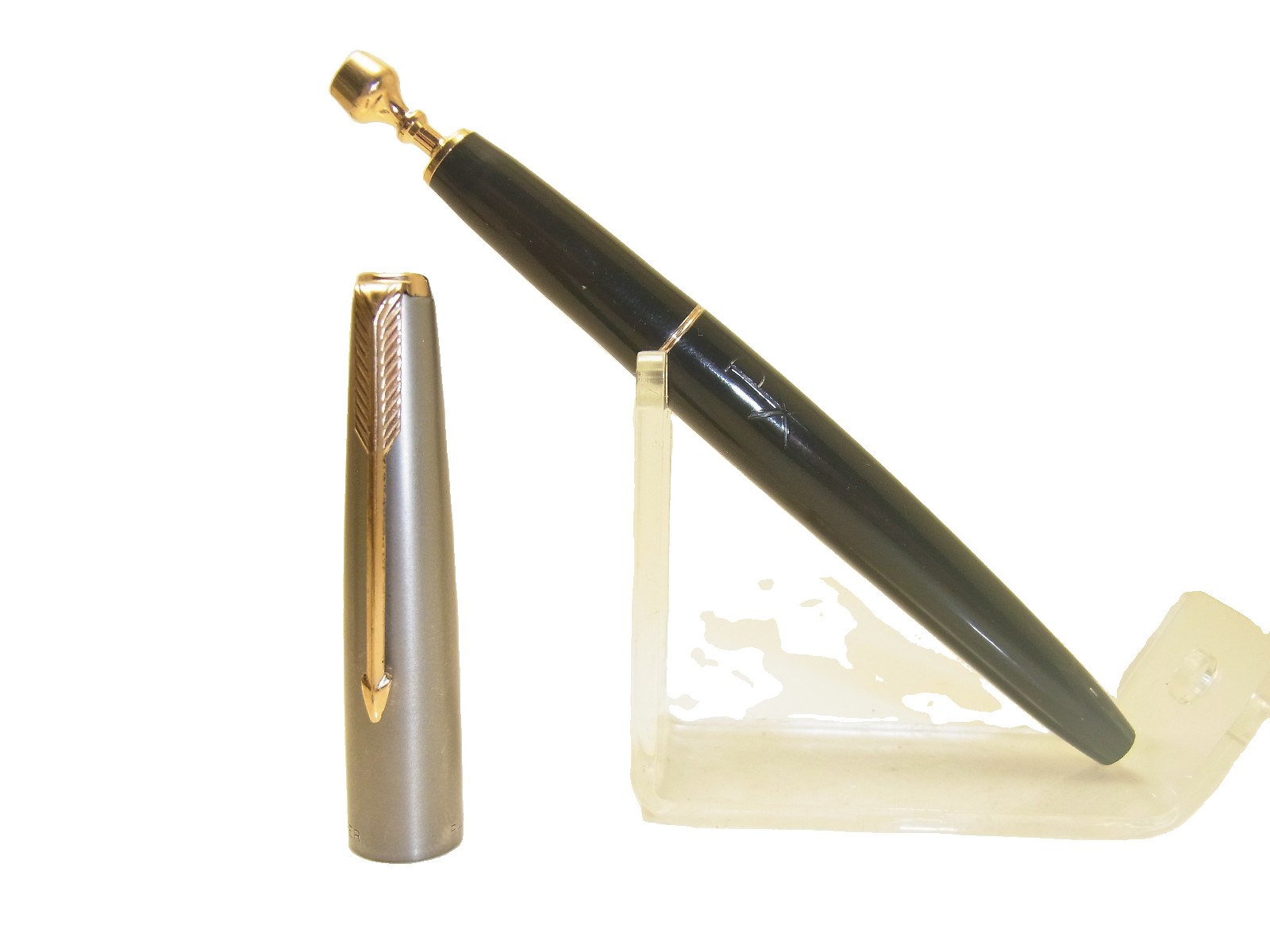
This week, whilst perusing the Nibfolio Marketplace I came across a Parker aspergilim. I had no idea what it was at first and so I did a little research and inevitably fell down a rabbit hole of researching other famous (or in some cases infamous) examples of objects that looked like regular pens but were used for a different purpose.
So here is my list so far. Wherever possible I have gone back to the patent, the museum record or the official report so we tried to distinguish fact from fiction (no James Bond exploding ballpoints, but we do have a gun!).
The Holy Water sprinkler / Aspergilum
An aspergillum is the sprinkler a priest uses to scatter holy water, usually a brush or a perforated ball on a handle. In the early 1920s a Chicago church-goods firm realised it could be made to look exactly like a fountain pen.
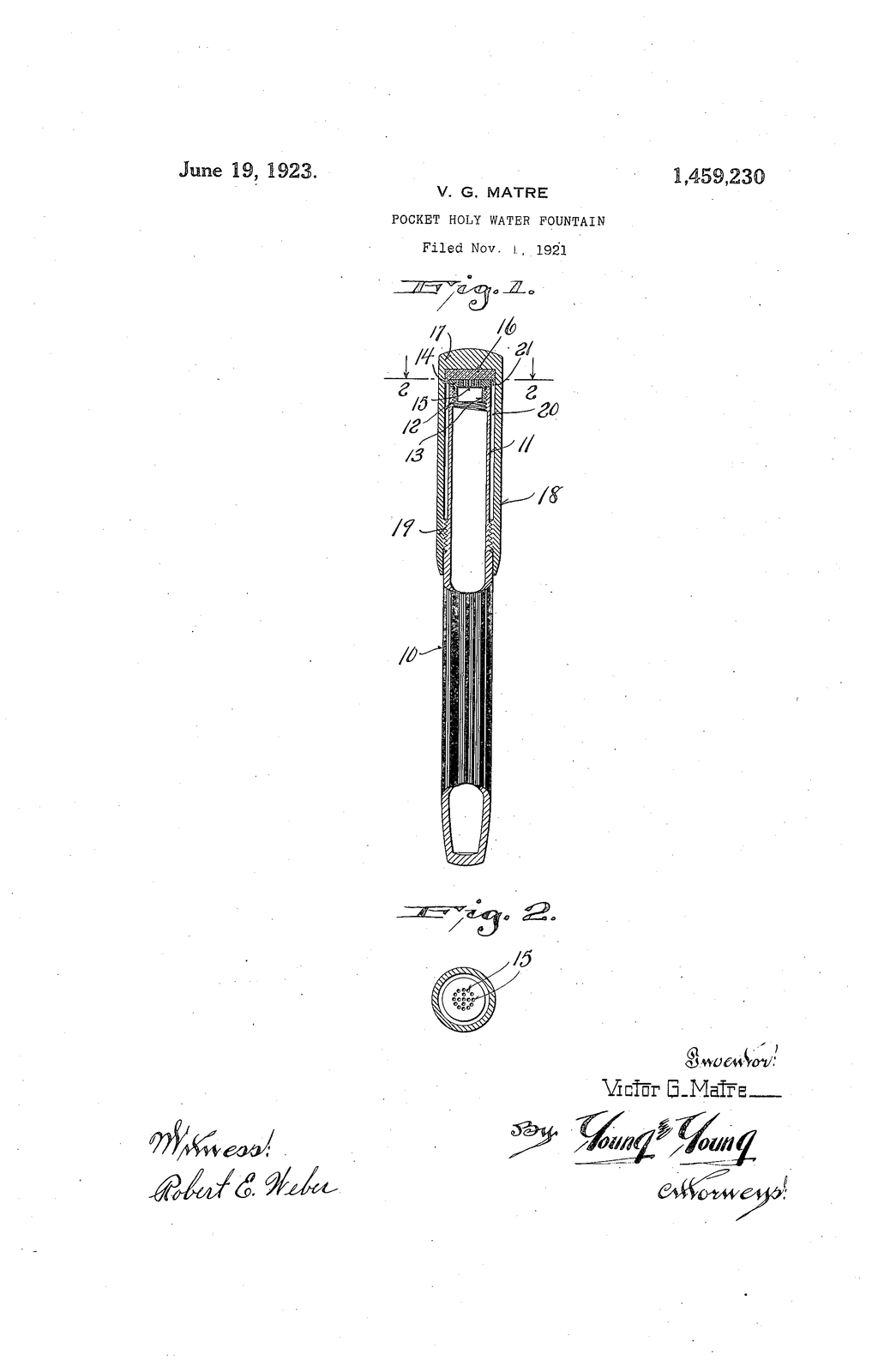
Victor G. Matre of Matre & Company filed his application on 1 November 1921, and US Patent 1,459,230, for a "pocket holy-water fountain", was issued on 19 June 1923. The patent is refreshingly frank about where the idea came from and it describes a device that resembles a fountain pen, has the conveniences of fountain-pen construction and can be made from the same materials. Inside there is nothing more than a cylindrical reservoir. The cap carries a nipple pierced with small holes, and a screw-on thimble presses a cork or rubber pad against them to stop leaks. To bless something, the priest removed the thimble and shook. A pocket clip was optional, "to prevent loss". Matre sold it as the Fountainette, a trademark registered in 1923, and surviving examples in black hard rubber are stamped "Pat'd 6-19-23", the patent's issue date to the day.
However, other pen manufactures joined in on the action too. The Swedish church historian Magnus Lundberg has traced the whole family through period advertisements and catalogues (Kyrkohistorisk årsskrift, 2024). By his account, Pick of Cincinnati advertised a "Pick-aspergil" in 1924, and Waterman offered a large eyedropper model 75 with an engraved cross and a five-hole lid in the late 1920s. Royal of Providence made an ebonite version inscribed Asperges me Domine in the early 1930s, LeBoeuf boxed a celluloid sleeve-filler as "Holy Water Asperges" in 1934, and Chilton sold black celluloid sprinklers with sterling cross inlays, in sets with a matching pen and pencil. Each maker simply pointed its own filling system at the font. In Parker's case that meant the Vacumatic, which the company's in-house newsletter pitched in 1935 not only to priests but to Catholic families keeping holy water at home.
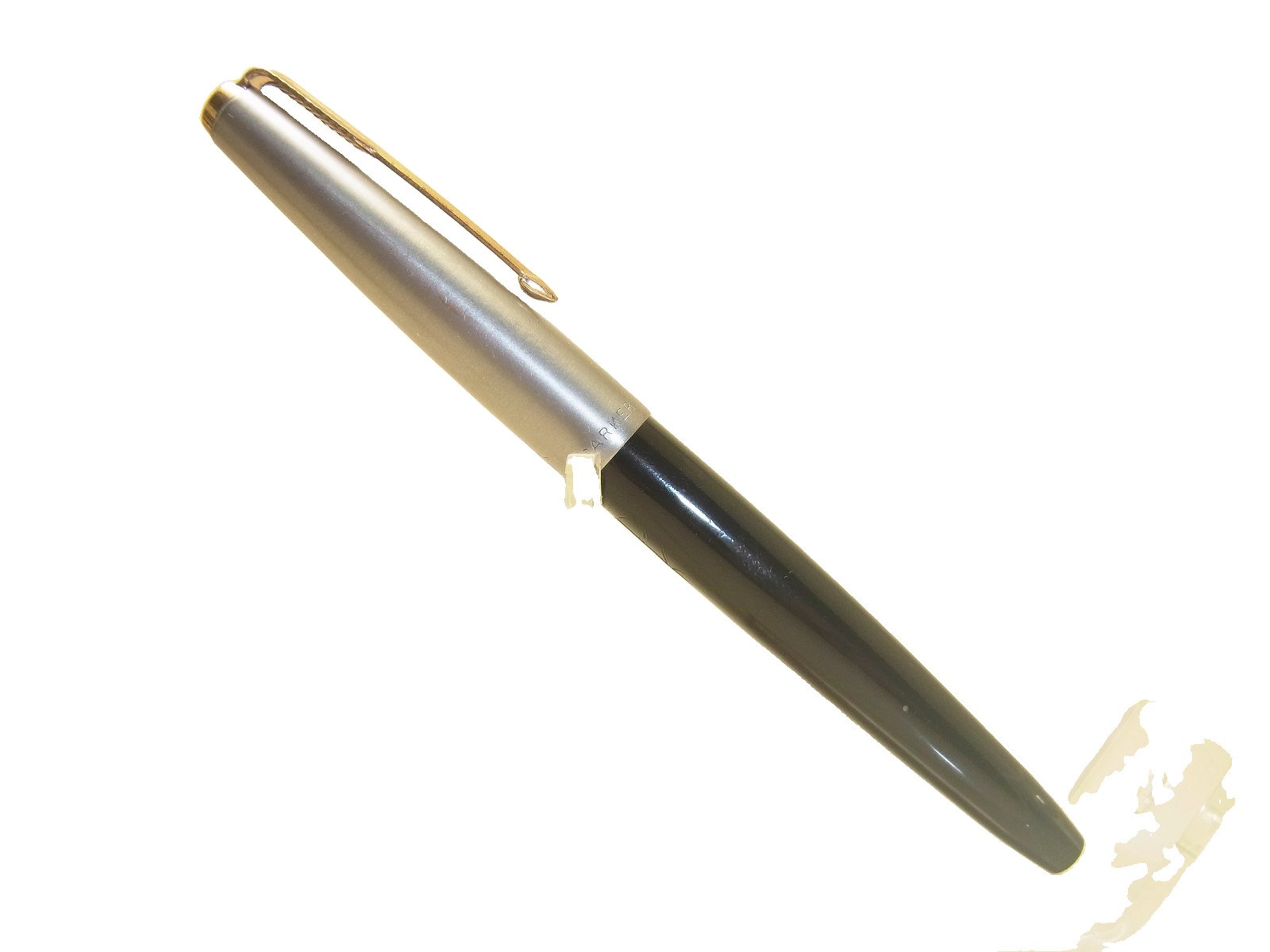
The last factory version is the one you are most likely to come across. Parker's VP sprinkler of 1962 to 1964 has a black body, a brushed Lustraloy cap and, where the nib should be, a gold-plated fitting shaped like a chalice, with a Chi-Rho embossed on the barrel. It was marketed to parishioners as a gift for their priest, and it accounts for roughly four in five of the examples Lundberg recorded.
Our favourite detail comes from a 1930 issue of The Indian Sentinel, which Lundberg cites. A missionary in New Mexico, carrying both a pen-aspergil and an ordinary fountain pen, reached for the wrong one at a wedding and blessed the groom with ink!!
There is a later footnote for Duofold owners. In the 1990s a screw-in brass sprinkler section, with a little goblet-shaped cup, was made to replace the nib section of a Parker Duofold International. Lundberg credits L. Michael Fultz and says it was made with Parker's permission.
The doctor's pen: a thermometer in the barrel
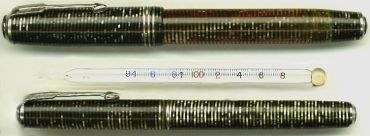
A doctor's top pocket held two essentials, a pen and a clinical thermometer, and the pen makers noticed. David Nishimura at VintagePens.com describes hard-rubber eyedropper "doctor's pens" with a thermometer stored in the barrel, drawn out from the end opposite the nib. Parker made the best-known version, of which very few survive, and Laughlin and OMAS made similar pens. More common in the 1920s and 1930s were doctor's sets, in which an ordinary pen came with a matching thermometer case; an early Waterman 52 set, for example, or a 1930s Parker Vacumatic set in silver pearl.
The idea is older than the 1920s. In 1899 Frederick Turton patented in Britain "A Combined Writing Instrument and Pulse Glass”. A cylindrical case with sight holes for a clinical thermometer or a small sand-glass for timing a pulse, its other end serving as a pen or pencil holder. In 1912 Sydney Tappenden went a step further with "A Combination Fountain Pen and Clinical Thermometer”, in which a tube screwed into the end of the pen's reservoir held the thermometer under its own screw cap.
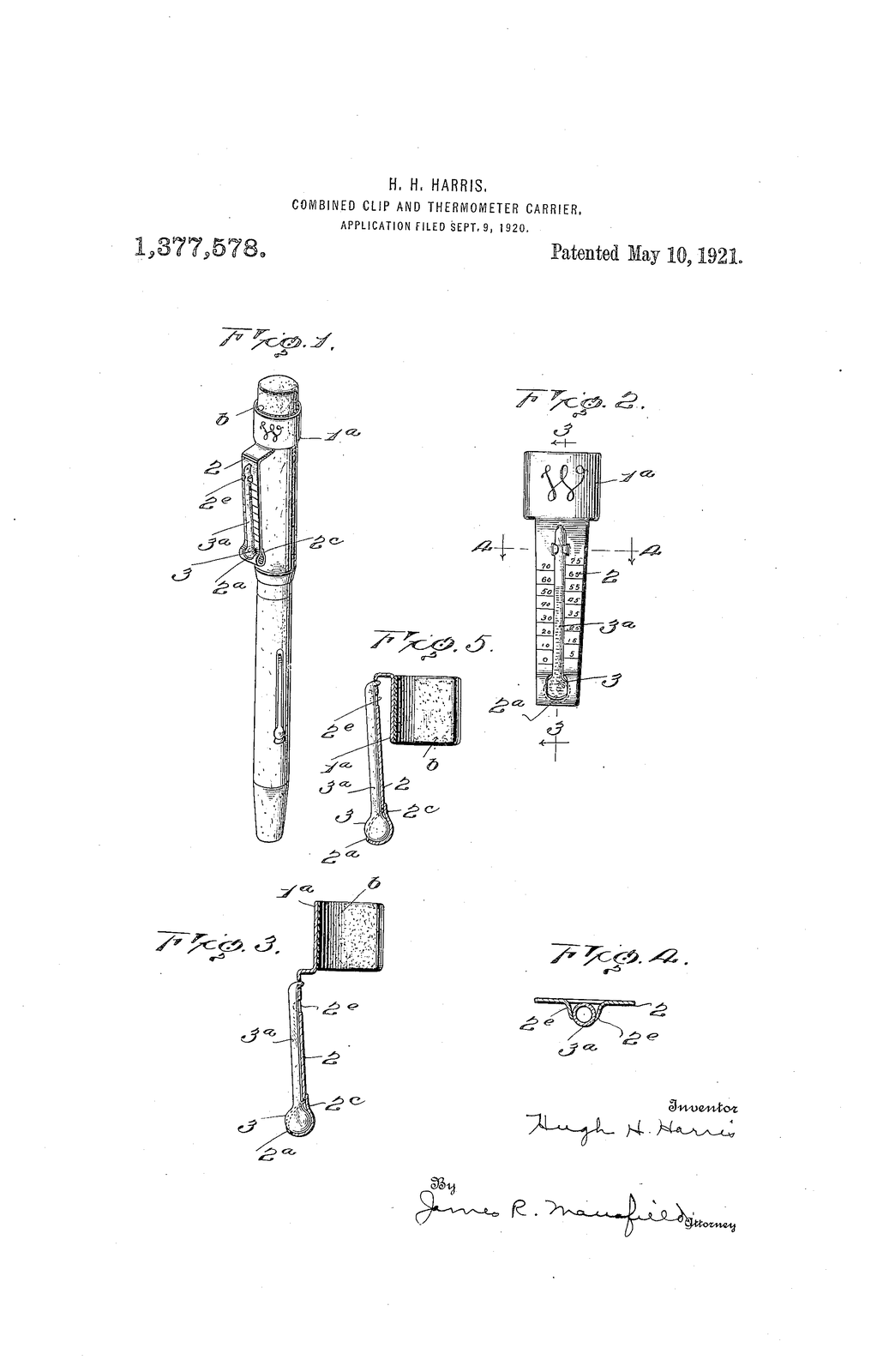
Not every solution needed a new pen. In 1921 Hugh H. Harris of Alexandria, Virginia, patented a pocket clip that carried a clinical thermometer and fitted onto "an ordinary fountain pen". The thermometer's bulb sat in a hole near the foot of the clip, so pen and thermometer went into the pocket together.
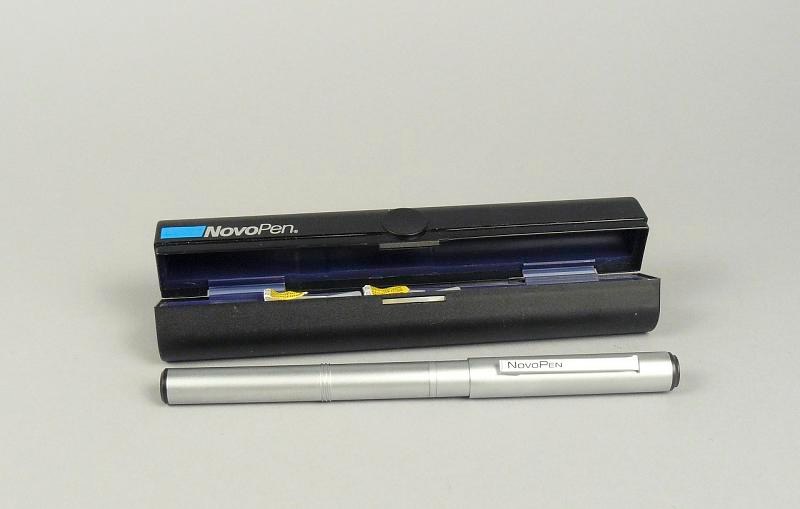
Staying on the medical theme, the first insulin pen, Novo's NovoPen of 1985, is described in the medical literature as resembling a fountain pen, and the Smithsonian holds an early Squibb-Novo example (see below image).
The Penciliter: a pencil that lights your cigarette
Ronson's Penciliter is an interesting example of clever design and engineering. Louis V. Aronson of Art Metal Works, the company behind Ronson, filed for US Patent 1,975,531, "Pencil and igniter", on 3 November 1933, and it was granted on 2 October 1934. At the front is an ordinary mechanical pencil. Behind it sits a fuel barrel packed with absorbent material soaked in lighter fluid. You draw out a removable steel "torch" with a wick, strike it against a flint-type strip on a telescoping sleeve, and use it like a match.
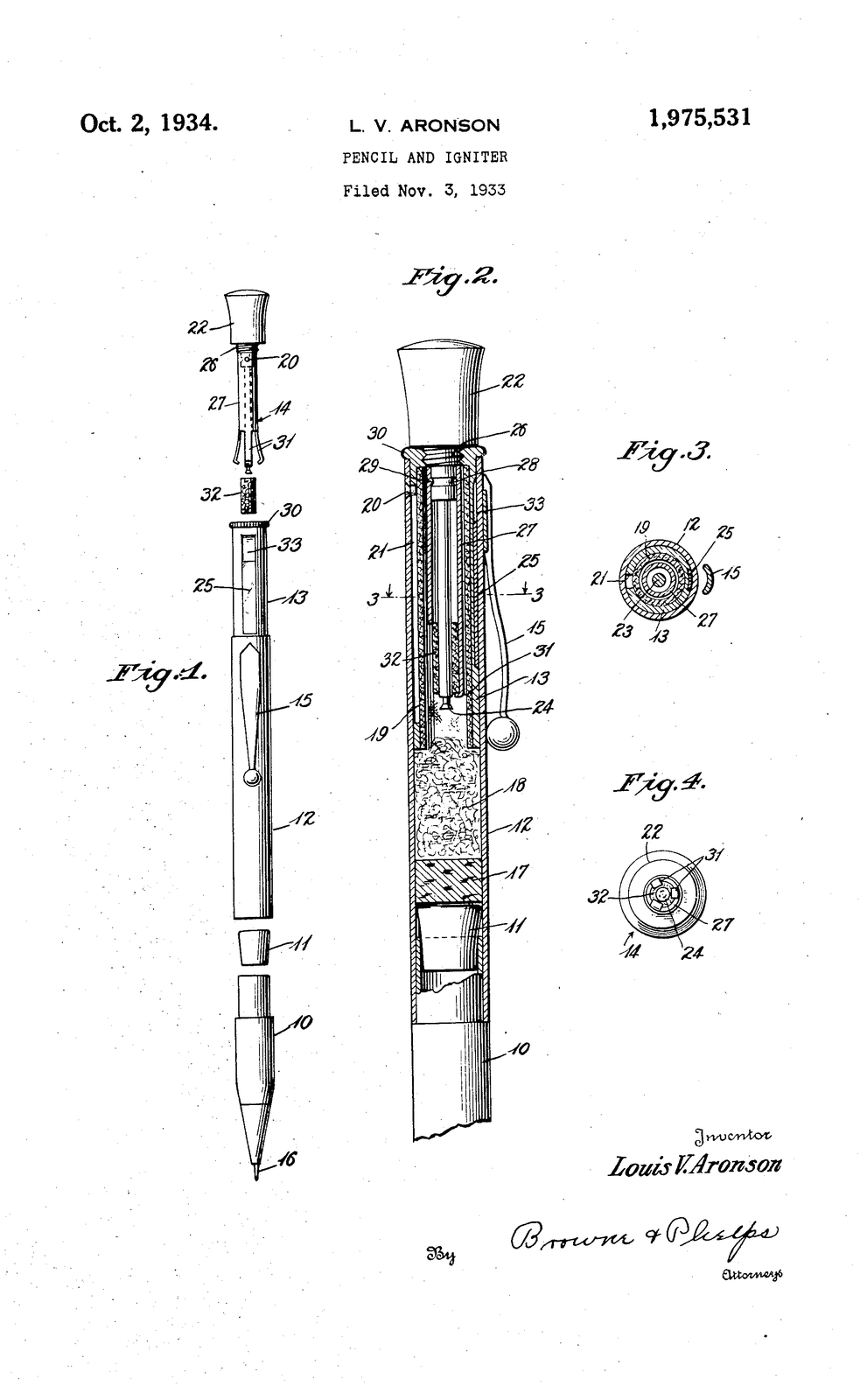
The patent never mentions the Penciliter by name, but it very probably covers the first generation, made from 1935 to 1948.
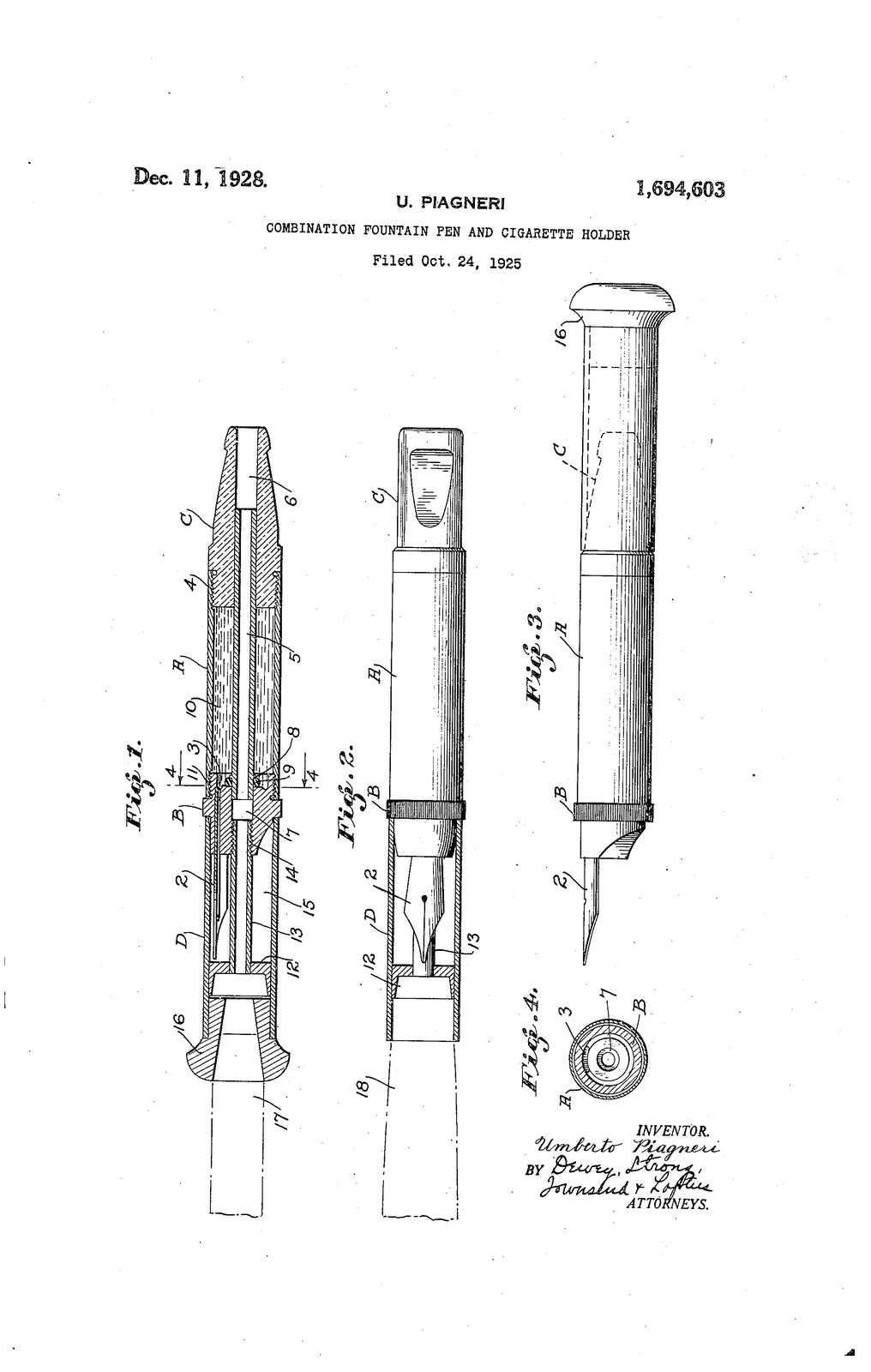
Others had tried to combine writing and smoking. Umberto Piagneri of San Francisco filed for a "Combination fountain pen and cigarette holder" in October 1925, and it was granted in December 1928. Its cap doubled as the cigarette holder, a mouthpiece fitted at the other end, and the smoke traveled down a central passage with the ink in a ring-shaped chamber around it (US 1,694,603). We have found no sign that it was ever made, which may be for the best!
Princess Pat: lipstick and powder in a pen
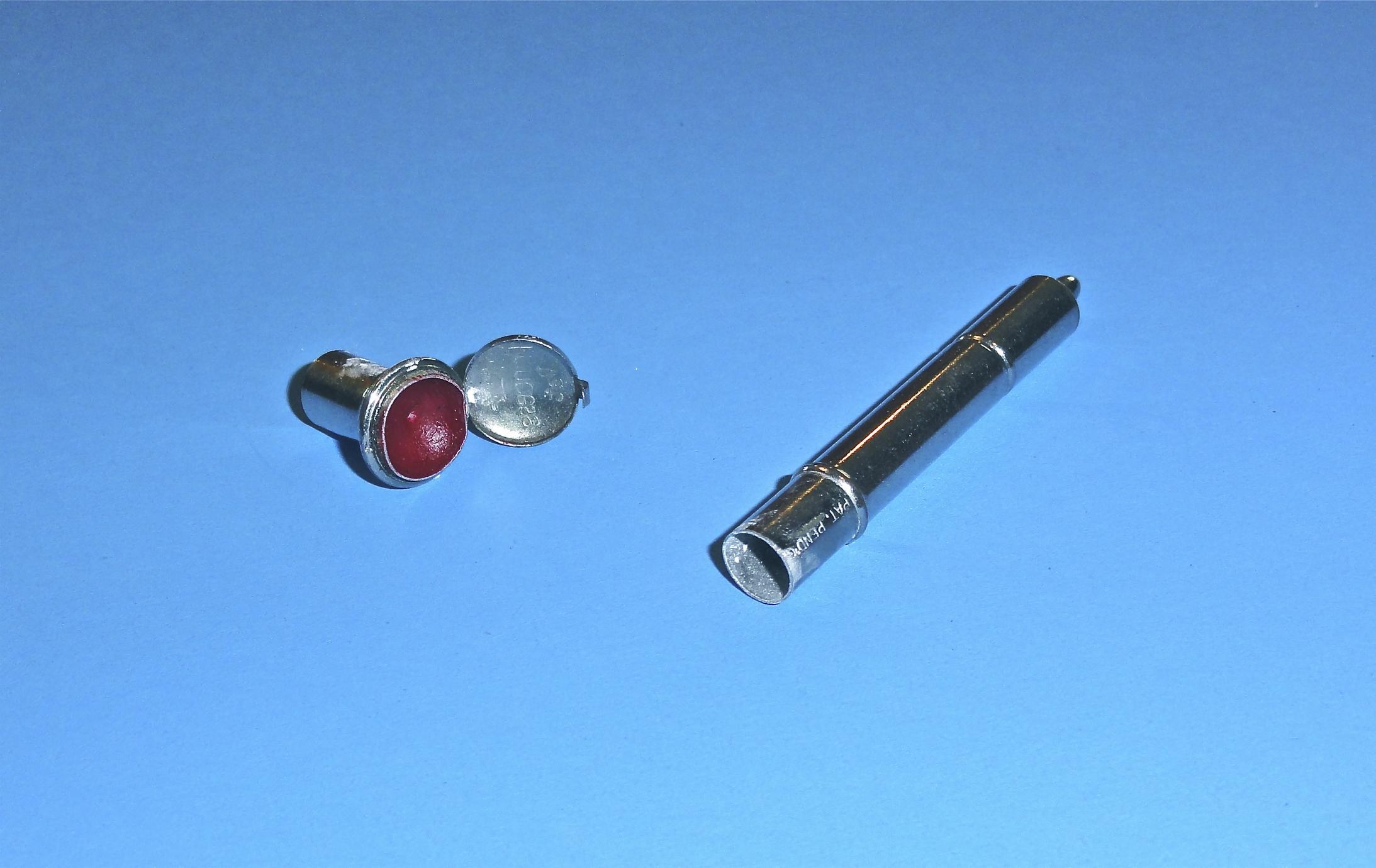
Not every pen-shaped object was made for a man's breast pocket. In the 1920s the cosmetics brand Princess Pat sold a pen-shaped holder just 3¼ inches long, now in the Dovie Horvitz Collection at the University of Wisconsin–Madison Libraries (2010.33.17). Flip open the hinged top and there is a lipstick. Pull the top out and you expose a cylinder of powder, released by pressing it down "as though writing with a pen". It is the most charming object on this list, and the only one in which the writing gesture is part of how it works.
The fountain razor
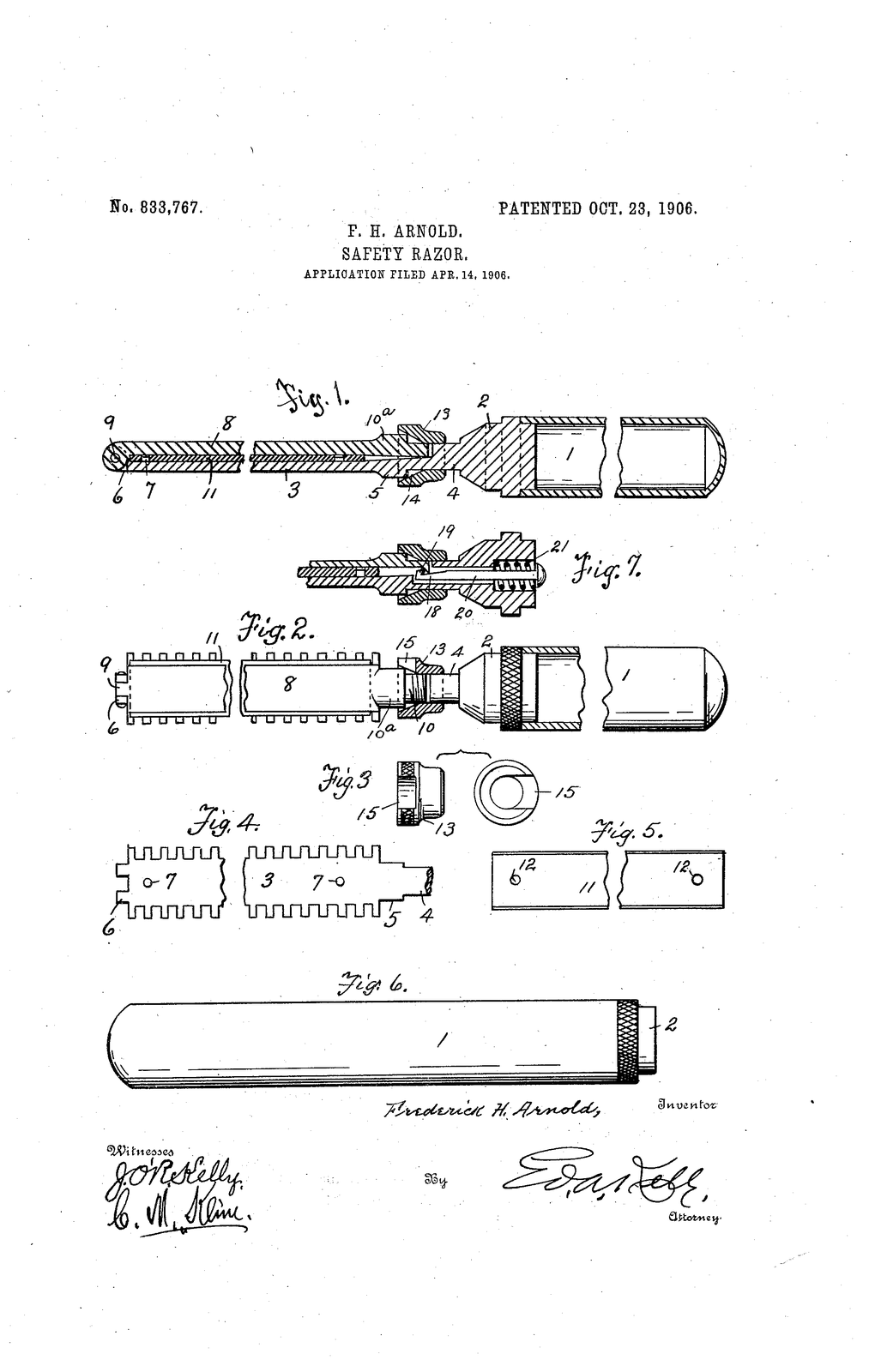
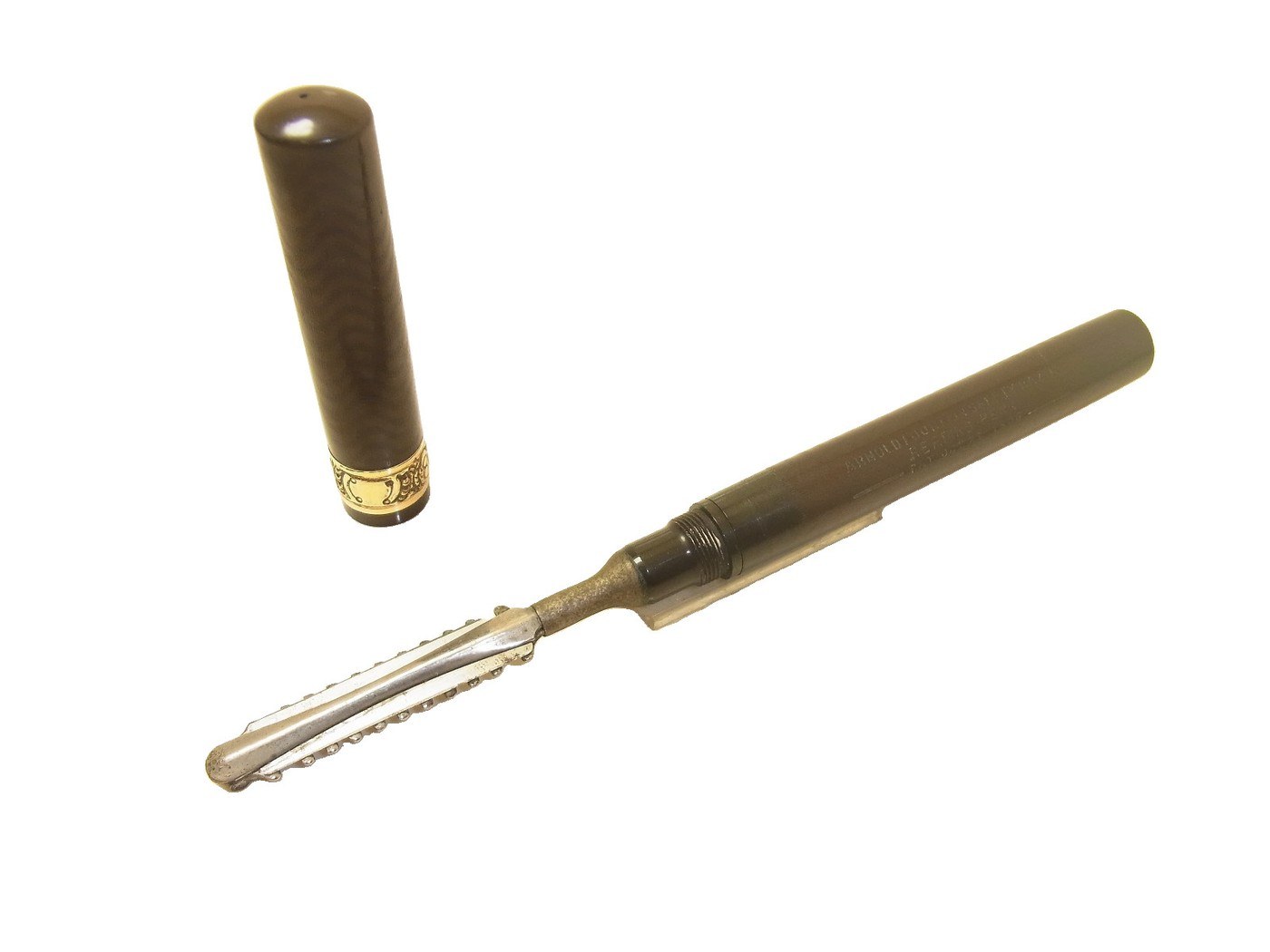
A gentleman travelling in the early 1900s could carry his razor in his breast pocket. One example is currently listed on our own Marketplace: an Arnold Fountain Safety Razor in a black hard rubber pen housing, listed by wasupen. The barrel is imprinted ARNOLD FOUNTAIN SAFETY RAZOR, READING PENN., PAT. OCT 23 1906. It measures 14.8 cm, and the cap posts on the end just as a pen's would.
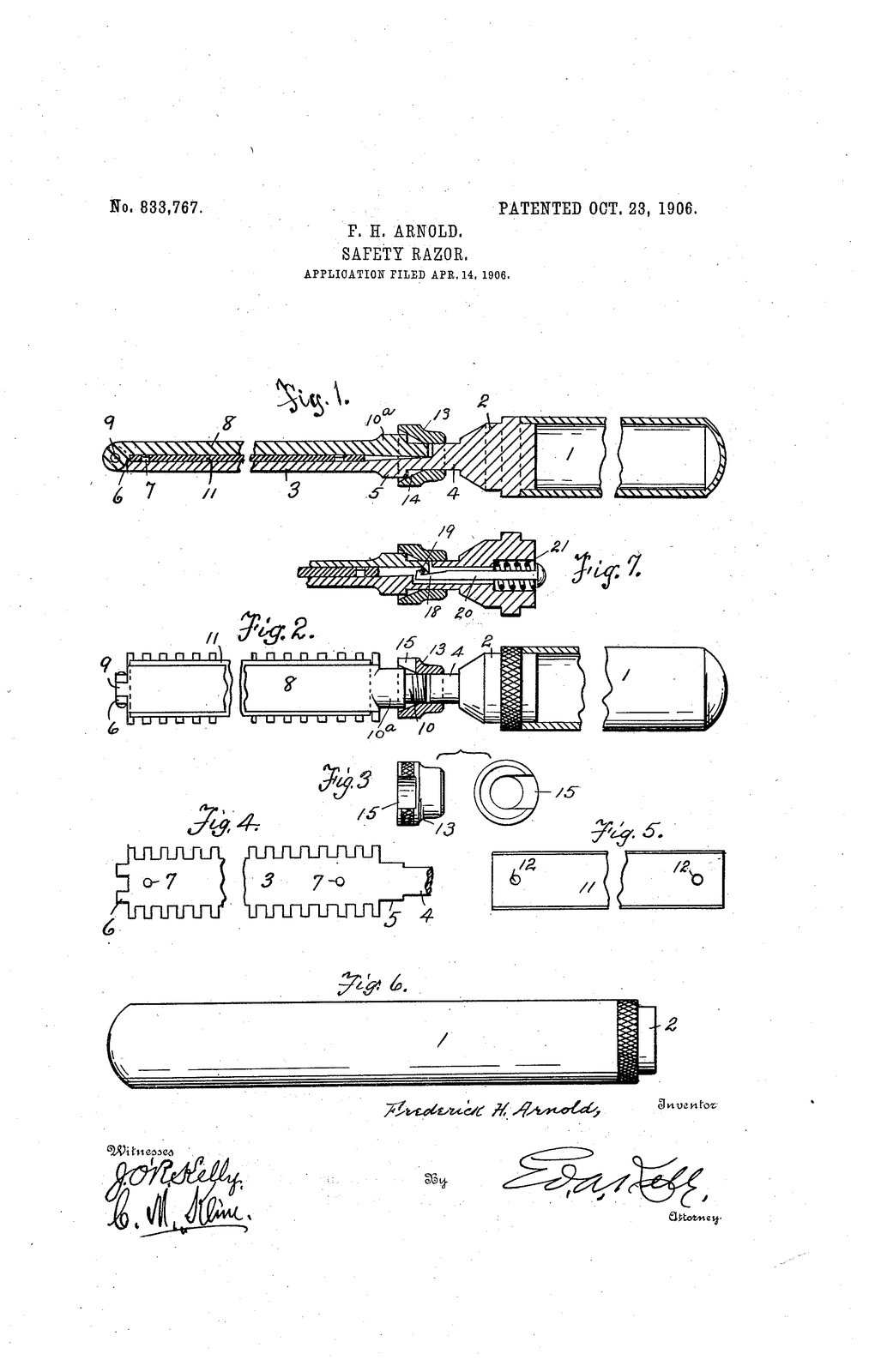
That date leads straight to the patent. Frederick H. Arnold of Reading, Pennsylvania, filed for US Patent 833,767, "Safety-razor", on 14 April 1906, and it was granted on 23 October 1906. One of its stated aims was a razor that could be "incased in a comparatively small tubular casing and carried with ease in the pocket".
The dosimeter: a fountain pen for the atomic age
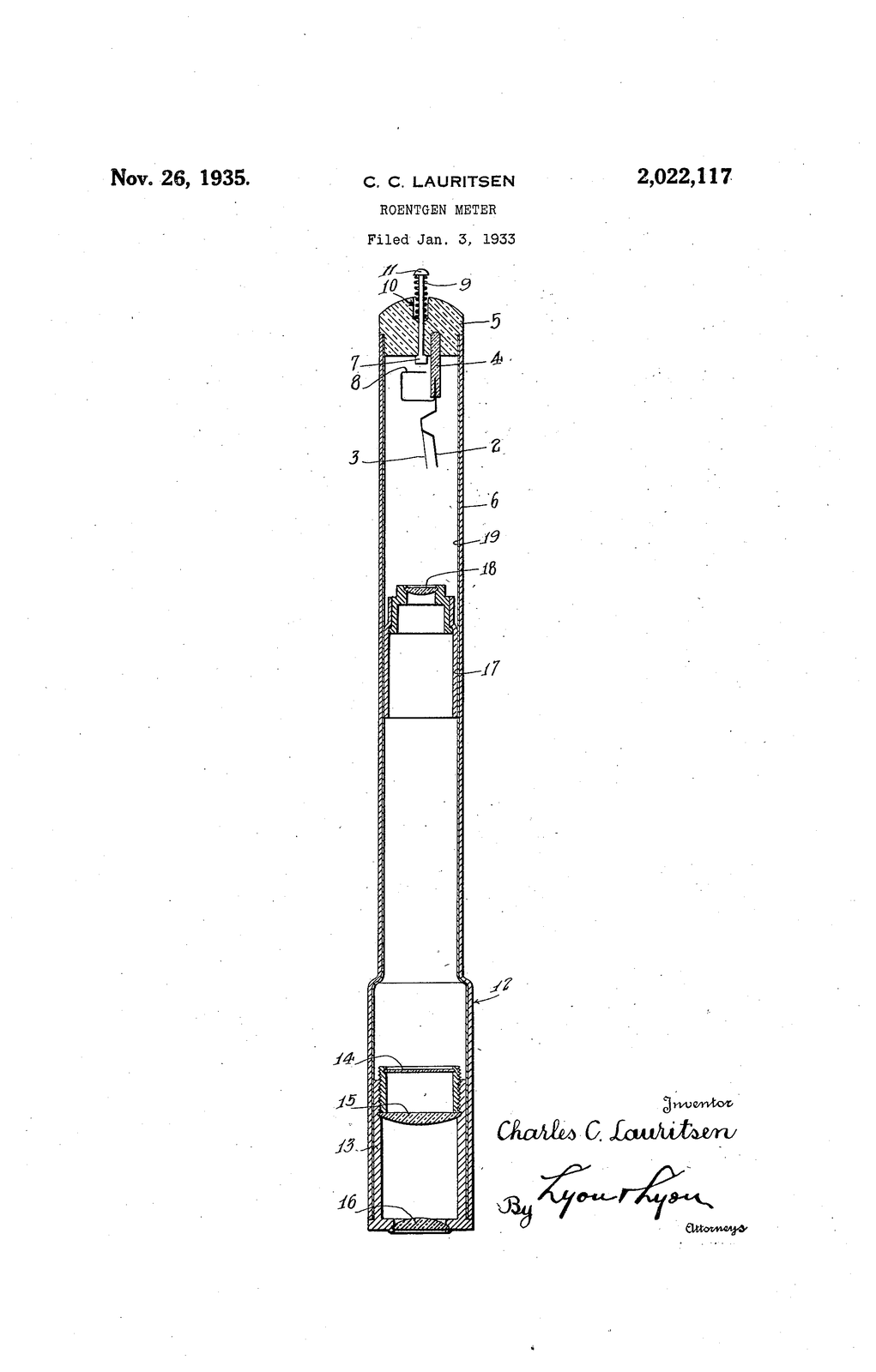
In December 1932 the physicist C.C. Lauritsen showed a hand-built portable radiation meter in Pasadena, and the United Press release said it resembled a fountain pen. His patent, filed on 3 January 1933 and granted in November 1935 (US 2,022,117, assigned to the California Institute of Technology), is more precise: the microscope, ion chamber and electroscope all fit "within a tube about the size of a fountain pen". Inside an aluminium housing were an ionisation chamber, an electroscope and a tiny microscope, you held it up to the light and read the shadow of a quartz fibre against a scale. That first example is now in the ORAU Health Physics Historical Instrumentation Museum Collection in Oak Ridge, Tennessee. However it doesn’t really resemble a recognisable pen at all.
The Cold War put the design into mass production. The US Civil Defense CD V-742, a 0 to 200 roentgen dosimeter made by Bendix, Landsverk and Victoreen, was bought from fiscal year 1961 onwards, and about 3,120,000 were made. It is described as resembling a fountain pen in size and shape: 4¼ inches long, half an inch across, with a gold or bronze pocket clip. Cambridge in Britain and Riken in Japan made pen-form dosimeters too.
The WW2 Escape Pencil
Ok, so not a pen per se but its within the overall theme!
MI9, the British department set up in December 1939 to help prisoners of war escape and evade capture, sent tools into the camps hidden in everyday objects, pencils among them. The best story belongs to the Cumberland Pencil Company of Keswick, now Derwent.
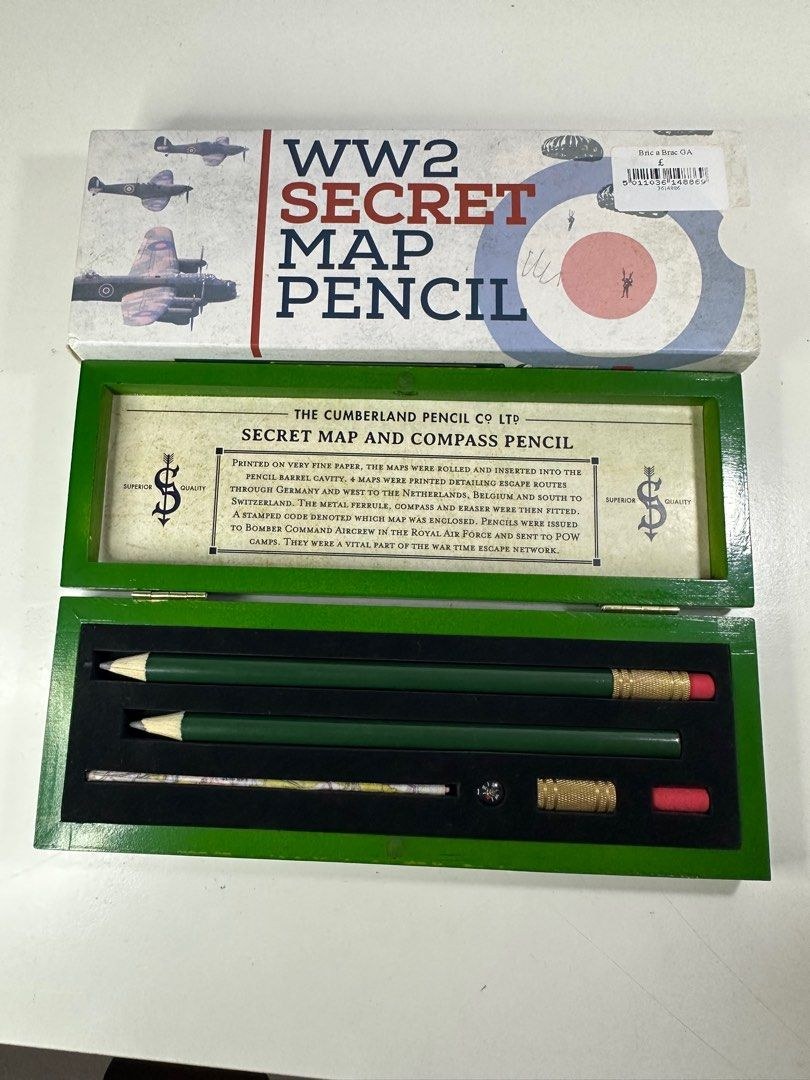
From 1942, according to one popular history, managers worked after hours removing the ferrule and rubber from pencils and drilling down from the top, leaving a few centimeters of lead so that the pencil still wrote. Into the hollow went a tiny compass and a tissue-paper map rolled around a wire. Four maps covered Germany and the routes into the Netherlands, Belgium and Switzerland, coded by the pencil numbers 101 to 104, and the method is credited to the firm's technical manager, Fred Tee.
The 'Pen Gun'
The pen gun was real and, for a while, entirely ordinary in the United States. The FBI's "Artifact of the Month" for October 2018 is a single-shot pen gun of 1924 in .38 Short Colt, made in two brass parts with a pocket clip, and the Bureau notes that such pens had been sold for self-defence since the early 1900s. The patent record runs from Byron C. Goss's "Fountain-pen-shaped pistol" (US 1,663,834, granted 1928) to Joseph Plachy's "Pen gun" (US 4,490,935, granted 1985), which claims to work as a ballpoint too.
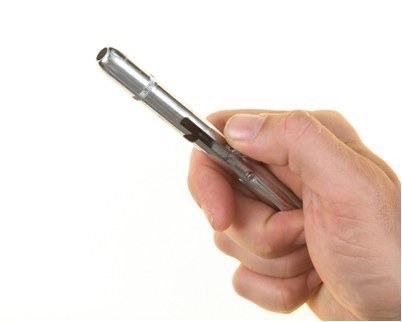
Tear-gas pens were far more common, sold over the counter and through men's magazines from the late 1920s onwards. William S. Darley patented a fountain-pen-shaped "Gas gun" for police use in 1930 (US 1,772,070), Peter von Frantzius patented a "Gas Pen" the same year (US 1,775,178), and one maker sold its version as the "PENGUN", with a bird engraved on the clip. The US Navy found a legitimate use for the form: its Mk 79 survival kit gave downed aircrew a "pencil-type" launcher with seven screw-in signal flares, carried in the survival vest.
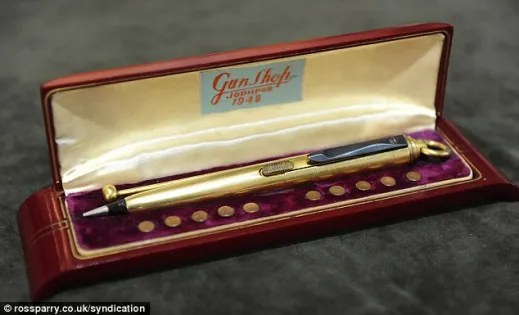
Another well known example is the "Mountbatten pen gun", a .22 pistol about seven inches long. According to press reports it was made by Maharaja Hanwant Singh of Marwar-Jodhpur and presented to Earl Mountbatten in 1948.
CIA Cyanide Pen
Aleksandr Ogorodnik was a Soviet diplomat recruited by the CIA in Bogotá in January 1974 and given the codename TRIGON. Before he returned to Moscow that October, he asked for a means of suicide in case he was caught, and the agency's Office of Technical Service modified a fountain pen to hide a cyanide capsule. The KGB arrested him in 1977 A pen using "similar tradecraft" is in the CIA Museum, and from the outside it is just a pen.
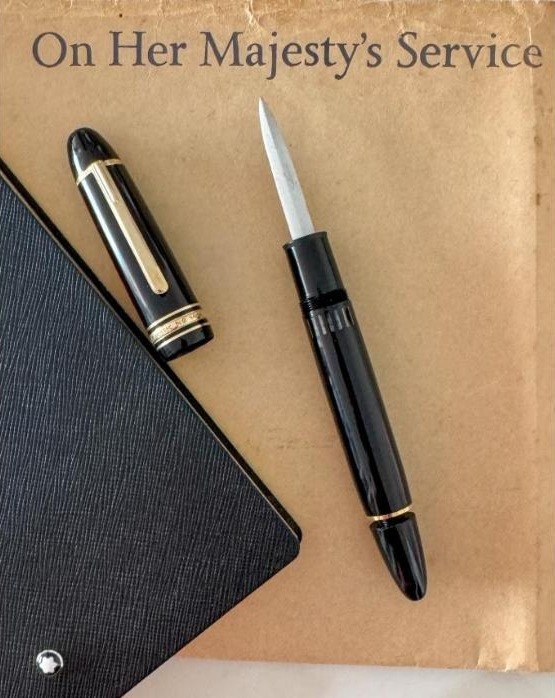
Concept Montblanc Letter Opener
From my own collection, I have a concept from Montblanc’s research and development work in the 1980s, in which a letter-opener blade has been fitted to a standard 149 piston mechanism. Turn the piston knob as if you were filling the pen and, instead of drawing up ink, the blade extends from the front of the barrel. The story that came with it is that Montblanc's designers of the period would raid the parts drawers and assemble concepts to show to management, at a time when Montblanc was a very different company from the one we know today. This one never went into production.
Lets make a Part 2?
This list is a start, not the last word. We are sure there are pen-shaped oddities sitting in desk drawers and collections that never made it into a patent office or a museum catalogue
If you own one, or know of one, tell us in the comments below or send us a message, ideally with photos, and tell us where we have gone wrong too. If there is enough, there will be a part two.